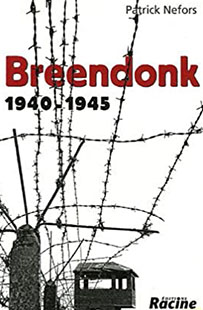
Hardcover edition, 2015.Paperback edition, 2020. |
~~ Suggestions for Visiting Fort Breendonk ~~ ~~ ~~ Related Books by James M Deem: ~~ |
Living in America?
One of the first prisoners that a visitor to the Fort Breendonk National Memorial learns about is Israel Neumann. An immigrant from Nisko, Poland, Neumann was incarcerated at Breendonk for some nine months before he was murdered. His story as presented on the audioguide at the memorial is heartrending.
Through my research, I was able to provide additional background information about Neumann, including some minor arrests for peddling without a license in Antwerp.
But my most surprising find was the fact, buried in his Belgium immigration documents from 1927, that his family lived in Brooklyn, New York.
I wondered: why Israel was in Belgium when his family was in New York?
Ellis Island passenger manifests revealed that Israel had immigrated to New York with most of his family (his parents Simon and Anna/Chana; three sisters named Cipora, Schifra, and Sima; and two brothers named Shie and Meilich) in 1921; their last name was misspelled as Neumain. They arrived on the SS Roussillon on February 1, 1921. Another son (Hyman Jacob) had preceded the family to New York and was living in the Bronx at 2074 Mapes Avenue. Another son named David arrived a month later on March 23, 1921. Two others, Bina Neumann Wisenfeld and Adolph Neumann, apparently stayed in Europe and did not immigrate tothe United States.
I was unable to locate any information on the family from 1921-1925. The first U.S. record of the Neumanns came in 1925 with the New York census of that year. Four years after their arrival, six members of the family (now spelled Newman) were residing at 570 Van Siclen Avenue in Brooklyn: parents Simon (a Hebrew teacher) and Anna with two daughters and two sons, all now with American first names. The daughters listed on the census were Sadie (most likely Schifra) and Sylvia (Sima); the sons were Sam (Israel) and Murry (Meilech; he later changed his name to Milton). Neither Cipora nor Shie were living with the family by then. Sidney had gone off on his own, and Cipora (Celia) had died July 11, 1921, just six months after her arrival.
Israel lived in the U.S. for four years. For unknown reasons, he applied for a Polish Passport at the Polish Consulate in New York on July 31, 1925. Sometime after that, he returned to Europe (most likely to Le Havre).
Did he have a falling out with his family? Did he miss Europe? Whatever the reason, he stayed in France for just over a year before deciding to return to the United States. He sailed from Le Havre to New York on the SS Caronia, and arrived in New York on October 11, 1926. The ship’s manifest lists his occupation as waiter and his last permanent residence as Nisko, Poland. The manifest also indicated that he spoke three languages: Polish, German, and English.
However, he was detained on Ellis Island for almost four months. The reasons for his detention remain unclear but may well have had to do with his perceived physical and/or intellectual challenges and the concern that he might not be able to support himself. Did he try to contact his family for help? There was no way to find out. On February 4, 1927, he was deported, most likely to France.
A few months later, he applied for residency in Belgium and moved there that May. Sometime after November 1930, he met Eleonora Sabathova who became his wife in a religious, not civil, ceremony. She had been born in Vienna on December 4, 1896. Her mother, Johanna Furth, died 18 days later on December 22, 1896. She immigrated to Antwerp in November 1930 where she lived with her brother Leopold Sabath for a short time. She worked as a housekeeper. By 1940, she was married to Israel Neumann. And after he was arrested and did not return home, she reported his disappearance to the police, giving a description of his clothing and appearance: "small size, dark eyes, lightweight overcoat, dark gray hat, striped trousers." He may have written her letters from Breendonk, but none have survived. To save herself from Nazi persecution, she entered a tuberculosis sanatorium in December 1941 for the duration of the war. After the war, she lived in a number of residences, primarily in Antwerp. No record of her can be found after 1969.
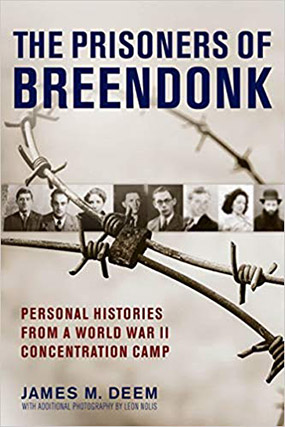
The rest of his tragic story involving his incarceration and murder at Breendonk is told in a series of chapters in The Prisoners of Breendonk.

Looking for Information
As I continued my research, I was able to learn more about the Newman family.
According to the 1930 U.S. census, Anna was a widow, living with Sadie, Sylvia, and Milton (changed from Murry). Sadie was an operator in a bra factory, Sylvia was a manicurist, and Milton made hats.
According to the 1940 U.S. census, Sylvia was now the head of the household. She was a beautician, Anna was a housekeeper for another family, and Milton was a tie salesman. They now lived at 1617 President Street in Brooklyn. All three had become naturalized United States citizens by then, and Milton joined the army on June 15, 1942. Both Sidney and David were married. Sidney and his wife Fannie had three sons (Julius, Seymour, and Saul); David and his wife Rose had one daughter (Libby).
The 1950 U.S. census indicated that only Sylvia and Milton were left; Anna had died in 1949. Further research revealed that Sidney died on January 12, 1950; Sadie died April 14, 1964; David died on January 3, 1967; and Milton died on December 11, 1980. I have not beeen able to locate any information about the death of Sylvia. And Bina Neumann Wiesenfeld and Adolph Neumann's fates are equally a mystery, though they may have been murdered in the Holocaust.
In the meantime, I am still trying to discover more information about the family and the family of Eleonora Sabathova. If you have any information you would like to share, please contact me.
A Stolperstein for Israel Neumann
On October 23, 2024, a stumbling stone or stolperstein (or struikelsteen in Dutch) ceremony was held at Magdalenastraat 20 in Antwerp. This was the place where Neumann had last resided befor his arrest. Four of Neumann's relatives from the United States, Mexico, and Israel were in attendance. Four speakers addressed the crowd of about seventy persons: Marc Weyns (Struikelsteen Committee), Jef Verlust (Site manager of Fort van Breendonk), James M. Deem (Author and professor), Susan Newman Cohn (Relative of Israel Neumann).
Here is a video summary of the event:
Visiting Israel Neuman's Memorial
Before the ceremony, relatives and other well-wishers visited the cemetery where his remains are buried in a memorial to other murdered Jewish prisoners from Breendonk.
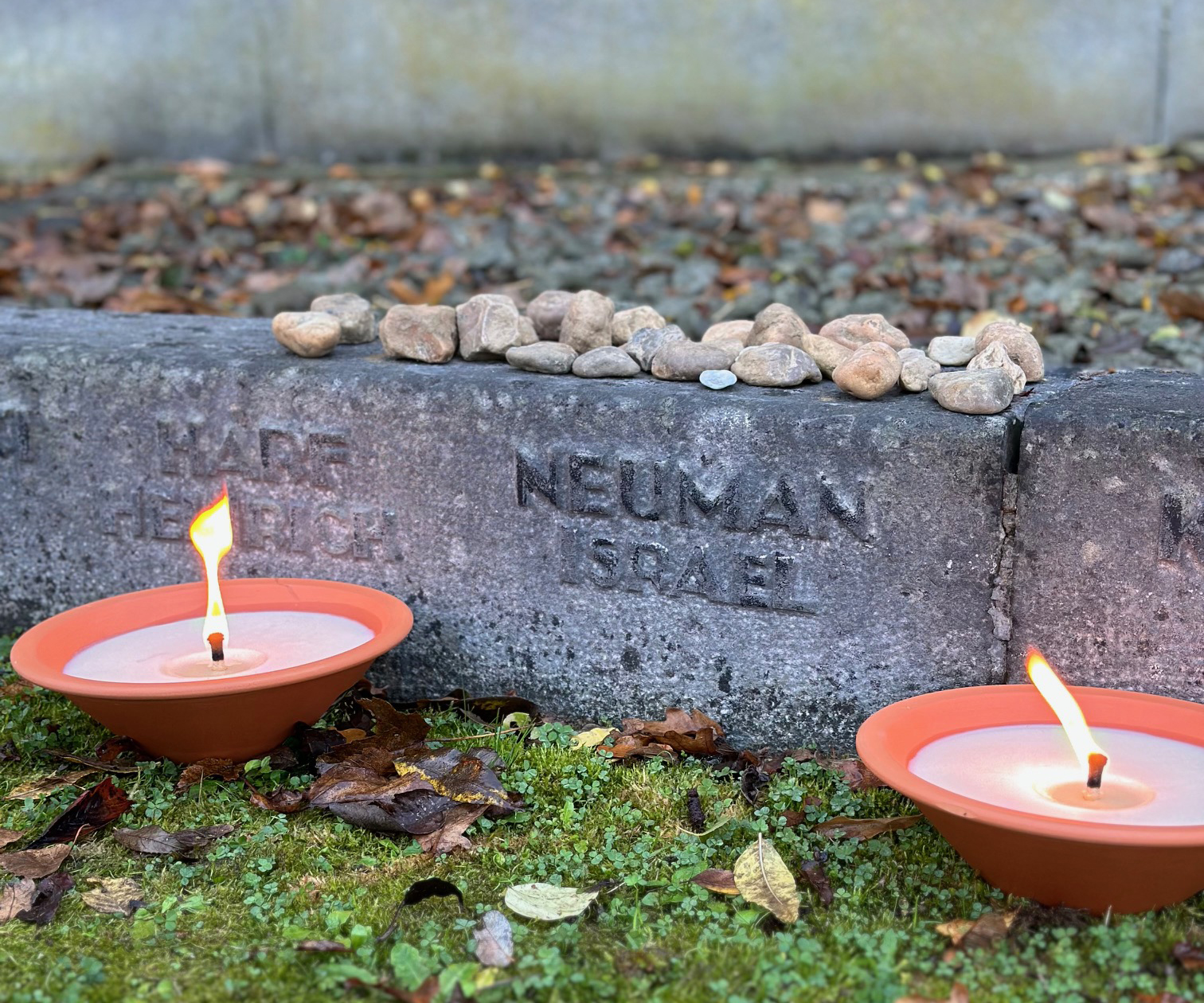
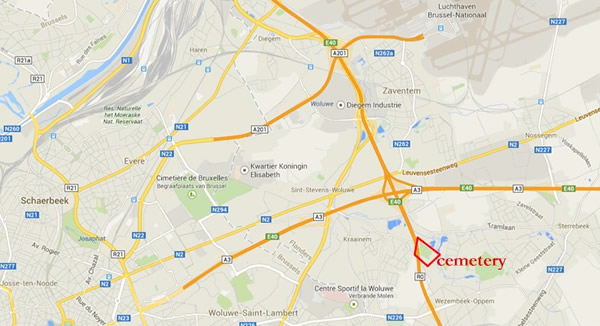
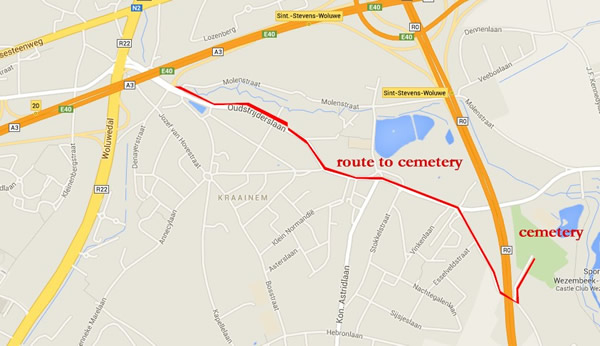
If you would like to pay your respects to Israel Neumann, you may visit the cemetery in Kraainem, a suburb of Brussels. Directions are given below.
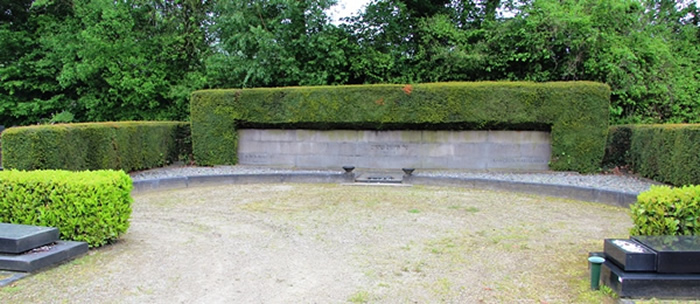
Memorial in Kraainem, Belgium, honoring some of the Jewish martyrs of Breendonk, including Israel Neumann
The memorial is located in the Jewish section of the communal cemetery of Kraainem (information in Dutch), a suburb of Brussels. It is near the intersection of the eastern Ring Road and the E40/A3, not far from the Brussels airport. An exit from the A3 will allow you to take side streets to the cemetery, as shown on the maps below.